Mind Power Author Stephen Richards

Mind Power Author Stephen Richards
MIND POWER AUTHOR - STEPHEN RICHARDS
Showing posts with label positive thinking. Show all posts

Thursday, 28 February 2013

How Gordon Sumner Used Positive Thinking To Make Fame Happen Before He Became Rockstar Sting - By Stephen Richards


Back in the 1970s, two young men were sitting in a Tyneside (England) pub at a table staring into the dregs of their beer. They were both down on their luck. However, one of the men said, "I’m just waiting for the chance to burst onto the world. I want to go to London and become a word-famous pop star and musician. I’m simply wasting my talents here in Newcastle. I've got to move on. I just feel special; that’s all. Is that so bad?” The man talking? Sting!

See the full story in the new book ‘Three Sumner Tales’ based on the Sting endorsed biography 'A Sting in the Tale' (the only biography about, and approved of, by Sting) by Sting's friend James Berryman.

Three Sumner Tales is a story of Sting the boy, the young man; it is an utterly stunning piece of work. Adapted by James Berryman into 3 x 30 minute semi-biographical situation comedies (TV sitcom) from the book ‘A Sting in the Tail’, the only biography about, and approved of, by Sting.

Each eye-wateringly funny dialogue in this e-book is based on real life events featuring Sting, Jim Berryman and related characters. It is set in 60s and 70s Newcastle before Sting rose to fame as the frontman of the band The Police.

Each of these real life scripts delivers some truly slick comedy, and Jim Berryman’s writing talents bring to each one of them a kind of magic that is quite hilarious and in the tradition of TV’s ‘Only Fool’s and Horses’, ‘Dad’s Army’ and ‘Fawlty Towers’. The intricate storylines in ‘Three Sumner Tales’ are delivered with a sprinkling of slapstick that has been lovingly-crafted. Even though these relate to some years after their setting, Jim Berryman’s writing is evergreen. Revealed within are issues of Sting’s personality, excitement and triumph, all set against a setting that will appeal to any age.   


COPYRIGHT STEPHEN RICHARDS

Resources for Stephen Richards: 
Subscribe (free - about 12 a year) to the mind power newsletter by Stephen Richards

Wednesday, 26 December 2012

Banish Bad Attributes And Wash Out All Negativity By Stephen Richards

The universe is known to be composed of the five elements of ether, fire, air, water and earth (forget the wood element for this explanation), similarly, the microcosm, which is the human body, is also composed of the five elements. Any deficiency (or excess) of these five elements in the body causes disease and disorder. The state of one's health depends on the delicate balance of these elements. It is the basis of creation and disintegration of atoms that cause construction and destruction.


The coming together of these five elements is birth, while its disintegration is death.We can go as far back as the Vedas in Eastern philosophy to see the earliest documentation of the attributes and powers of the cosmic elements. These Tattwas or cosmic elements are the principle of the ether or akash. Light or Tejas is the principle of fire while Vayu is the principle of the air. Apas is the principle of the water and prithiviis the principle of the earth. Air, water, earth and fire are the four gross cosmic elements descended from the fifth tattwa or cosmic element, the akash tattwa. Hence, the akash or the ether is the essence of all the cosmic elements.Communication, reception, as well as transmission with the Cosmos, is achieved through the ether element. The ether element is the basis of the creation of the other four elements. The four elements emerged from the ethereal principle.

Fire Element Fire (Agni)
Since the principle of ether or akash is the origin of all the other cosmic elements, the first element born from akash is believed to be Tejas, the principle of fire or light. The influence of the fire element is manifested not only on the material plane but also in everything that is created in the universe. The main attributes of the agni tattwa are the qualities of fire - heat, expansion and light. At the beginning of creation, the first element must have been that of fire and light.

Evidence of this is found in the Old Testament that reads 'Fiat Lux - let there be light. The origin of the light, heat and life must, therefore, originate in the fire element or the agni tattwa. Each cosmic element including fire has two polarities. I.e. The active and the passive one, which means positive (+) and negative (-). A positive polarity indicates the constructive, creative, productive influence of the agni tattwa, whereas a negative polarity of the agni tattwa represents the destructive and dissipating influence of the fire element. There are always two basic qualities which are identified with each element, the good and the bad. Over the time, man/woman has labeled good as active and badas passive.

However, according to the law of the universe, there is nothing like good agni tattwa or evil agni tattwa. These are purely human perceptions based on the influence of these elements on human life. Everything in the universe is created based on the divine principles and in accordance with the divine law of cause and effect. The agni tattwa has the capacity for expansion. This expansion is known to us through the creation of the universe, our planetary system, along with the sun. The power of the fire element of expansion and contraction is still evident when the hot lava, the molten mass in the core of the Earth creates earthquakes and volcanoes on the surface of the Earth. Agni, or the fire element, allows the expansion, spread and extension of mass when it is in its active mode but provides warmth for the growth of life in its passive mode. However, no matter which substrate the fire element works through, it will always lend qualities of expansion, extension, heat and light. These qualities vary in the degree of intensity according to the nature of their substrate.


How to Banish Bad Attributes and wash out all of your negativity
Have you ever been abroad, say the Mediterranean, have you noticed how good you feel within yourself, as if you are a new you? Well, that is because you are a new you! How can this be? Discover the secret of the opening your heart to the cosmic element of fire in the sun, and receive its energy and banish all your negativity, the bad attributes of your personality and your bad habits. I do not mean for you to spend hours and hours in the sunshine like these sun worshippers on the beach … no!

Soon you will find the negativity that surrounds you automatically beginning to evaporate. Positive energy will begin to diffuse into your being as you begin the process of washing out all your negativity. This fire element is in the form of heat energy as well as light energy. Hence, the sun signifies both, the light as well as the energy aspects of the fire element or the agni tattwa.     Light (tejas) is another attribute of the fire principle. Light without fire is inconceivable.

Everything that is extremely hot is associated with light energy. Light and fire can be said to be two sides of the same coin. Light involves all the specific qualities such as shining, penetrating, expanding and producing warmth.The opposite of light is darkness, which has come out of the principle of water. Darkness has the contrasting specific qualities of light. Without darkness, light would not only remain quite unrecognisable, but without darkness there would never be any light at all. Evidently, light and darkness must have been produced by the mutual play of two elements, those of fire and water.Light in its outcome has the positive quality, whereas darkness has the negative one. This interplay is the working of all regions of the Cosmos and so, on the microcosmic level, each event has a dark side as well as a light side, pros and cons.Since the principle of light (tejas), an attribute of the fire (agni) element, is illumination, brightness, warmth, enhancement of the faculties of passion, meditation, clarification of desire, creativity, prosperity, magnetism and development of the right side of the brain are associated with this fire element. On the negative side, explosions, accidents, fights and arguments are said to be most heated when the fire element is most predominant. 


Water Element (Apas)
The principle of the apas tattwa or water element is considered to be the opposite of the fire element. Although, originating from the same etheric or akash principle, it has almost opposing qualities in contrast with the fire element. These basic qualities are coldness and contraction. The water element (apas) has two poles of polarity. The positive polarity is associated with its capacity for life giving, nourishment and protection, whereas the negative polarity is associated with destruction, division, fermentation and spoilage. As this element possesses the basic qualities of coldness and contraction, it has acquired a magnetic fluidlike property.

Where the fire element has an electrical field component to it, the water element has a magnetic fluid effect. Fire, as well as water, operates in all regions and coexists according to the rules of creation. The fiery principle would not be able to exist all by itself if it did not have an equal and opposing principle of water to balance out its presence and effects. Along with ether, the fire and water elements are the two main cosmic elements from which all creation has emerged.The inherent quality of the principle of water is purification and cleansing. It contains the highest form of healing through the magnetic vibrations inherent in the cosmic element of water.Hydrotherapy has been known since ancient times. Water heals the physical problems, body pains, mental depression and psychiatric problems.

Fire and water together are best for healing.Hot water baths, hot water bottles, hot steam treatments and hot springs stand as testimony to the combined healing that the fire and water element provide when they work together. A fever or a body ache is quickly cured with a hot or cold shower. Cold compresses are said to relieve pain and cold water splashed on the race is said to make one feel more refreshed and charged. The power of cleansing with the element of water has a therapeutic effect both on the mind as well as the body. Within religious ceremonies and beliefs, holy water is often sprinkled to charge individuals with positivity. Here, again the element of water is used to dispense spirituality and purge the evil. Jacuzzis and bath rubs with aromatherapy would be a lost cause if the element of water did not have healing powers.Water is the pure force of energy which is why we harness energy from it in the form of hydroelectricity. Since the quality of the principle of water is flowing, magnetism and healing, it is often associated with money, business, journeys, travel, sensitivity and the ability to feel. 


Air Element (Vayu)
The air element is derived from Akash. Initiated people do not regard this principle as a real element, but they will grant it the role of a mediator between the fiery and the watery principles. The role of mediation between the water and fire element is taken up by the principle of air. Everything that is velocity and motion corresponds to Vayu, the principle of air. It acts as a carrier as well as a medium for both the cosmic element of fire as well as water. Both steam and humidity require the element of air and the transmission of heat are possible only through air. The principle of air, in a certain way, establishes the neutral equilibrium, acting as a carrier medium between the active and the passive activities, of water and fire respectively. The cycle of rain, clouds, wind and heat that gives us our seasons would not have been possible without the active and motion-driven principle of the air element.

The principle of air is the principle of breath. Breath is ignited by the fire principle. When breath is ignited the oxygenated air mixes with the blood, the water principle which gives our body life. This is on the microcosmic level. The distance of the planets and stars in the solar system is maintained due to the differing pressures of the air principle. Along with speed and velocity, another attribute of the air principle is pressure. The balance of pressure is necessary to both the air element as well as the Cosmos. Air is the food of the fire principle as is evident through the process of combustion. Air is the food of the water principle through steam and humidity. Hence it nourishes these principles, water and fire.

Without the substrate of the air principle, both fire and water are unable to demonstrate their prowess.The attribute of speed and velocity in the principle of the air is the manifestation of winds, gusts and gales. When associated with the fire principle, this wind can be harnessed as a desert storm, when associated with the water principle it can cause storms and cyclones, once again demonstrating how the principle of the air element sustains the activities of the water and fire principles in nature. This is the picture in the macrocosm. A microcosmic perspective reveals that an excess of air principle in the gastric fire leads to the common complaint of gas leading to stomach pain. Air associated with pressure and the water element leads to low or high blood pressure.However, the element of air has healing powers, too. The element of air is non-manifested in that it can be sensed through touch and smell but cannot be seen. Therefore, all healing that comes through it cannot be seen. It is transmitted in the form of vibrations that reach the receiver. Purification of the surroundings can be observed only through the principle of the air element. A foul-smelling environment smells foul because the air element carries the bad odor. A clean smell is no smell, and a sweet smell is any smell pleasing to our olfactory senses.

Winds, air, aerial navigation, etc are related to Vayu or the principle of the cosmic air element. Any unwholesome deed, committed in the air element, results in an imbalance of energies - a common cause of disasters. All kinds of simple and quick business transactions turn out well when the principle of air is predominant. Fast, speedy, intellectual works bear quick results when the air element predominates. High mountains like the Himalayas are said to harness vast amounts of cosmic energy because of the strong winds on the mountains, where the winds can be very powerful, and the energies can be utilized by yogis for their spiritual upliftment. 


Earth Element (Pritvi)
The principle of the earth element emerged from the ether principle as a result of the solidification of the air, fire and water elements. It was the last element created in the Cosmos. The solid nature of the earth principle enables it to possess shape and form. The expanding and contracting forces of the fire element, the motion of air and the attraction of the water principles all lead to the dense nature of the earth. The reciprocal action of all the forces of the fire, air and water elements, in conjunction with the earth principle, leads to a terra polar force that is so strong it behaves like a four pole magnet.

The fluidity of the earth principle, along with this strong magnetic force, empowers it with a strong electromagnetic force which is why it is capable of attraction. This force is what we often refer to as gravity. In partnership with the fire element, the earth can thus sustain this diverse biosphere. Each of the elements, from which the earth principle is composed, can be found both in complex as well as simple form on its surface, as well as within its interior. This vast magnetic attractive force enables the Earth to literally pull high amounts of energy of varying kinds from the Cosmos. It has the capacity to attract vibrations from the smallest frequency to the highest frequency.

The connectivity to the solidity of the Earth makes life on it fulfilling. When the higher energies of the Cosmos can be attracted by Earth through the vehicles of its inhabitants, they are said to connect to the principle of divinity.The more that the Earth attracts this divine energy to its surface, the more eternal happiness proliferates over its surface. This divine energy has the quality to further embellish the beauty of nature, thus softening all the crude and base instincts of its inhabitants. Life on Earth is characterized as filled with joy and happiness.

To receive life on Earth is considered a tremendous boon, as the Earth offers its inhabitants immense possibilities and opportunities, making their journey worthwhile. The Earth’s capacity to attract energy from the Cosmos is its strongest attribute. The strong electromagnetic force of the Earth gives so much resilience to its inhabitants that they learn to cope with their difficulties with immense strength.Each of us is aided by cosmic energy by virtue of the Earth, a huge magnet, sucking in this energy.

This is what aids inhabitants of Earth and makes it habitable, despite all the trials that may come one’s way. The enormous magnetic quality of the Earth is also immensely powerful. This type of energy can be found not only in holy places but in other places as well, especially in nature. Nature itself has healing energy. Health sanatoriums and resorts are often located in the lap of nature, with scenic beauty around them. The magnetism of the earth principle in such areas is able to suction off all the negative energy. It helps people discharge their stress and relax emotionally. The earth principle offers every being energy on its surface, such that each soul can become potentially divine. Elevation, salvation and healing are the attribute of the earth principle. It is the principle where dreams can be realized.If success, good health, nutritious food and drink are desired, the earth principle will help us to achieve those in life. The very nature of the earth principle is love, charity and benevolence. 


Ether Element (Akasha)
This element extends into the universe. This represents the realities of the state of being. For what I am teaching you here, simply understand it as an element of the universe. 


Microcosm and the Five Elements
The atoms of the cosmic elements existing in different matter are present in the human body, too. They lend the same quality, power and energy as those in the macrocosmic Cosmos. Any excess or deficiency of any element in the body causes imbalance, inequality and disorder in mind and body. These imbalances are what we refer to as disease, disorders and ailments.

The presence of foreign bodies leads to physical and mental diseases and disorders when the body tries to get rid of them. Nature has made and created the human body in such a manner that, through the spaces in the body, the head cavity, the thorax, the abdominal and pelvic cavity, the human body is able to automatically purge any accumulated foreign matter from its being. However, if it remains in the body, the disease can become chronic or even fatal. Diseases and disorders of the mind and body are actually warnings and suggestions from the nature to cleanse, to oust from and to balance the body.

Nature itself has provided the human body with switches to control the elemental composition of the body. These switches were known to the ancient seers of India. They developed a study based on using these switches to eliminate any mind or body-related disease by the manipulation of the cosmic elements within the body. Our five fingers represent the elements of the Cosmos. With the help of our fingers we can form different arrangements to balance the imbalanced cosmic elements in the body. These finger positions, or switches, instantly alter the elemental composition and remove energy blockages in the human microcosm.

The tip of the thumb represents the centre of the fire element. The tip of the index finger is the centre of the air element. The tip of the middle finger is the center of the sky element. The tip of the ring finger is the centre of the earth element. And finally, the tip of the little finger is the centre of the water element. We can effectively combine and balance the five elements of the body by forming different positions with fingertip pressure. The placement of each finger pattern changes the effect of each cosmic element within our being. We can, therefore, influence energies from these elements of the universe to balance the body. It is within our own bodies that nature has endowed us with the power to control the cosmic elements. If we utilize this power in a proper way and achieve a positive state of mind and health, then what works at the microcosmic level works on the macrocosmic level. It is the imbalance in the cosmic elements that is the cause of natural disorders. When order resumes in the microcosm, it translates and magnifies into the macrocosm. This is the law of nature. 

 The Circum-Hand   
There are a few examples in nature of the use of fives and tens. Both a sand dollar and a starfish have five radial extensions from the centre. And ten balls can be stacked into a stable tetrahedral shape. “And we have ten fingers!” you might be saying. One might wonder if this is some cruel joke: to count by sixes or twelves and give man only five fingers.

Of course, we certainly have only four fingers, with one thumb. This thumb is an opposable appendage, and that is particularly significant because this opposition is the evolutionary advantage that enabled Homo sapiens to grasp and use tools. This thumb is displaced from its opposing position and function, and made to lie, as an imposture, next to the longer and skinnier appendages in an attempt to form ‘five in a row’. By saying “five fingers per hand” we are unconsciously idealizing a primitive, non-tool-using morphology. This leads back to where we came from.However, even the four true fingers do not form uniform-length sticks or rods as is implied in our number system. On the contrary, when one examines them one is likely to be surprised at their varying lengths, for in our minds we have been conditioned by our current grouping system to think of them (all five) as being uniform in size and length. Their tips form the outline of a curve rather than a straight line. This hints at another possibility.

Study this figure above. Notice that the human hand when maximally extended can make a fairly good approximation of the circle. If we now count the number of radial extensions we see six! Only now does the thumb seem to hold its own with the other four, and these four do not seem of such varying lengths as they did when we forced them to stand next to one another as if at a parade.Is it possible that the human race has never learned to count in all these millennia? Like the schoolchild, who, when asked to count the number of people in the classroom, always forgets to count himself, have we forgotten to include the stem of our hand in our counting system? 

Look at how humankind views nature. We commonly forget to include ourselves as part of it. Nature is in fact most often defined as anything that is not human or not built by humans.Is it too much to imagine then, that we have forgotten to include ourselves, represented by the wrist, in our counting system?Perhaps we still recall the time, at some impressionable age, probably much earlier than we suspect, when a grandparent, uncle, or parent, in an effort to advance us in knowledge beyond our peers, held up his or her hand and counted to five.“Five fingers” was repeated so many times, and reinforced by our numerical system, that we learned to accept it without question.

Later, in school, we learned that there are twelve inches to a foot. This confused us, especially if we had not the advantage of working with an enlightened merchant. We may even have thought, “Why not ten inches?”Then we were introduced to the metric system as being superior, and we accepted the centimeter, again without question. By the time we grew and became involved in the work-a-day world, where a practical knowledge of a dozen and a gross were useful, we had become so accustomed to ten that we may have wondered why dozens were even used. (It would be amusing to do a survey of businessmen to see if they use the dozen/gross and why.)Let’s call this new view of the human hand, with six radial extensions, the circum-hand (or hexa-hand or round-hand) and the old hand, the linear hand.Can one count on one’s fingers using the circum-hand? Certainly!

With a little practice, it is just as easy as counting by fives. One merely taps or flexes the wrist for six and its multiples. Perhaps an open palm with fingers together wound represent zero. Or, perhaps, the traditional circular shape for zero, made with the index finger and the thumb, would work.

But old associations die hard, and the linear hand is one of the oldest. It would be appealing to teach some particularly young (un-brainwashed) children circum-hand association.I consider the development of the circum-hand, an alternative to ‘five-fingers-per-hand’, to be an important step. However, it should be mentioned that counting on the three sections of the four fingers (using the thumb as a counter), which gives twelve, is a method of counting that is used in several countries. It may that this model is better than the six-per-hand model. (Although the spherical hand model reflects the spherical nature of things.)

Copyright Stephen Richards

Resources for Stephen Richards:

Monday, 24 December 2012

Wish It, See It And Be Rewarded By It By Stephen RichardsRichards

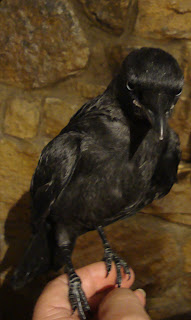
Jacky Can Over Two Weeks After I Rescued Him
ABove is an image of the more powerful Jacky Can the day before he returned to be with his parents, well fed and now grown into an even more handsome chap.

A number of weeks after I had rescued him from behind my fireplace (fallen chimneypot nest), my wish for him to survive and to be released back into the wild came true. I suspended a lot of my life for him, and now I was to be rewarded. My visions of him flying with his parents was about to become fact. I had visualized Jacky flying, it was a real image for me and now was soon to transpire.

Never for one minute did I doubt that Jacky would be in flight and soaring free. That is the same belief you have to apply to anything you want to manifest in life.
In compariison to the image above, here's Jacky the day after I rescued him
What now seems like thousands of mealworms and many efforts to get him airborne, Jacky, today, eventually made it back to his parents.

I had kept Jacky outside during the day so as to keep him in contact with his parents, as they had a dialogue going on but Jacky just wouldn’t leave the garden and they wouldn’t come close enough to get him to go with them.
The fledgling Jacky having a bath
Jacky became quite at home in my garden, although I monitored him as there are just too many predatory cats around. He even had a bath in a bowl I leave out for the other birds to drink from.

Jacky drying off after his bath
Jacky Can, back where he started from
Happy ending picture above shows Jacky back where it all began, on the chimney pot his nest fell down to behind my fireplace from.

After some hard work by Jacky he eventually responded to the calls of a number of other jackdaws, first tentatively flying on to a gate post, then a higher wall and then to a roof top. About 10 jackdaws were involved in calling Jacky, and eventually the call of the wild become so strong that he acted on it and up he went.

Still now, a number of hours later, he is airborne and comes and goes to the chimney pot it all started from, accompanied by his parents this time.

It was some work involved in looking after him, time consuming and at times mentally draining, but all worth it to see him back with nature. 

POEMS ABOUT JACKDAWS

The Jackdaw of Rheims

The Jackdaw sat on the Cardinal's chair!
Bishop and abbot and prior were there;
Many a monk and many a friar,
Many a knight and many a squire,
With a great many more of lesser degree,
In sooth a goodly company;
And they served the Lord Primate on bended knee.
Never, I ween,
Was prouder seen,
Read of in books, or dreamt of in dreams,
Than the Cardinal Lord Archbishop of Rheims!

In and out
Through the motley rout,
That little Jackdaw kept hopping about;
Here and there
Like a dog in a fair,
Over comfits and cates,
And dishes and plates,
Cowl and cope and rochet and pall,
Mitre and crosier! He hopp'd upon all!
With saucy air,
He perch'd on the chair
Where, in state, the great Lord Cardinal sat
In the great Lord Cardinal's great red hat;
And he peer'd in the face
Of his Lordship's Grace,
With a satisfied look, as if he would say,
"We two are the greatest folks here to-day!"
And the priests, with awe,
As such freaks they saw,
Said, "The Devil must be in that little Jackdaw!"

The feast was over, the board was clear'd,
The flawns and the custards had all disappear'd,
And six little singing-boys--dear little souls!
In nice clean faces and nice white stoles,
Came, in order due,
Two by two,
Marching that grand refectory through!
A nice little boy held a golden ewer,
Emboss'd and fill'd with water, as pure
As any that flows between Rheims and Namur,
Which a nice little boy stood ready to catch
In a fine golden hand-basin made to match.
Two nice little boys, rather more grown,
Carried lavender-water, and eau de Cologne
And a nice little boy had a nice cake of soap,
Worthy of washing the hands of the Pope.
One little boy more
A napkin bore,
Of the best white diaper, fringed with pink
And a Cardinal's Hat mark'd in permanent ink.
The great Lord Cardinal turns at the sight
Of these nice little boys dress'd all in white:
From his finger he draws
His costly turquoise;
And, not thinking at all about little Jackdaws,
Deposits it straight
By the side of his plate,
While the nice little boys on his Eminence wait;
'Till, when nobody's dreaming of any such thing,
That little Jackdaw hops off with the ring!

There's a cry and a shout,
And a deuce of a rout,
And nobody seems to know what they're about,
But the Monks have their pockets all turn'd inside out.
The Friars are kneeling,
And hunting, and feeling
The carpet, the floor, and the walls, and the ceiling.
The Cardinal drew
Off each plum-colour'd shoe,
And left his red stockings exposed to the view;
He peeps and he feels
In the toes and the heels;
They turn up the dishes; they turn up the plates,
They take up the poker and poke out the grates,

They turn up the rugs,
They examine the mugs:
But, no! - no such thing;
They can't find THE RING!
And the Abbott declared that, "when nobody twigg'd it,
Some rascal or other had popp'd in and prigg'd it!"

The Cardinal rose with a dignified look,
He call'd for his candle, his bell and his book!
In holy anger and pious grief,
He solemnly cursed that rascally thief!
He cursed him at board, he cursed him in bed;
From the sole of his foot to the crown of his head;
He cursed him in sleeping, that every night
He should dream of the devil and wake in a fright;
He cursed him in eating, he cursed him in drinking,
He cursed him in coughing, in sneezing, in winking;
He cursed him in sitting, in standing, in lying;
He cursed him in walking, in riding, in flying,
He cursed him in living, he cursed him in dying!--
Never was heard such a terrible curse!
But what gave rise
To no little surprise,
Nobody seem'd one penny the worse!

The day was gone,
The night came on,
The Monks and the Friars they search'd till dawn;
When the Sacristan saw,
On crumpled claw,
Come limping a poor little lame Jackdaw!
No longer gay,
As on yesterday;
His feathers all seem'd to be turn'd the wrong way;
His pinions droop'd - he could hardly stand,
His head was as bald as the palm of your hand;
His eye so dim,
So wasted each limb,
That, heedless of grammar, they all cried, "THAT'S HIM!
That's the scamp that's done this scandalous thing!
That's the thief that's got my Lord Cardinal's Ring!"
The poor little Jackdaw,
When the Monks he saw,
Feebly gave vent to the ghost of a caw;
And turn'd his bald head, as much as to say,
"Pray, be so good as to walk this way!"
Slower and slower
He limp'd on before,
Till they came to the back of the belfry door,
Where the first thing they saw,
Midst the sticks and the straw,
Was the ring in the nest of that little Jackdaw!

Then the great Lord Cardinal call'd for his book,
And off that terrible curse he took;
The mute expression
Served in lieu of confession,
And, being thus coupled with full restitution,
The Jackdaw got plenary absolution!
When those words were heard,
That poor little bird
Was so changed in a moment, 'twas really absurd.
He grew sleek and fat;
In addition to that,
A fresh crop of feathers came thick as a mat!
His tail waggled more
Even than before;
But no longer it wagg'd with an impudent air,
No longer he perch'd on the Cardinal's chair.
He hopp'd now about
With a gait devout;
At Matins, at Vespers, he never was out
And, so far from any more pilfering deeds,
He always seem'd telling the Confessor's beads.
If any one lied, - or if any one swore,
Or slumber'd in pray'r-time and happen'd to snore,
That good Jackdaw
Would give a great "Caw!"
As much as to say, "Don't do so any more!"
While many remark'd, as his manners they saw,
That they "never had known such a pious Jackdaw!"
He long lived the pride
Of that countryside,
And at last in the odour of sanctity died;
When, as words were too faint
His merits to paint,
The Conclave determined to make him a Saint;
And on newly-made Saints and Popes, as you know,
It's the custom, at Rome, new names to bestow,
So they canonized him by the name of Jim Crow!

The above was by Reverend Richard Harris Barham

The Jackdaw

There is a bird who, by his coat
And by the hoarseness of his note,
Might be supposed a crow;
A great frequenter of the church,
Where, bishop-like, he finds a perch,
And dormitory too.

Above the steeple shines a plate,
That turns and turns, to indicate
From what point blows the weather.
Look up -- your brains begin to swim,
'Tis in the clouds -- that pleases him,
He chooses it the rather.

Fond of the speculative height,
Thither he wings his airy flight,
And thence securely sees
The bustle and the rareeshow,
That occupy mankind below,
Secure and at his ease.

You think, no doubt, he sits and muses
On future broken bones and bruises,
If he should chance to fall.
No; not a single thought like that
Employs his philosophic pate,
Or troubles it at all.

He sees that this great roundabout,
The world, with all its motley rout,
Church, army, physic, law,
Its customs and its businesses,
Is no concern at all of his,
And says -- what says he? -- Caw.

Thrice happy bird! I too have seen
Much of the vanities of men;
And, sick of having seen 'em,
Would cheerfully these limbs resign
For such a pair of wings as thine
And such a head between 'em.
By William Cowper

Copyright Stephen Richards

Resources for Stephen Richards: